


Google's November 2026 core update: what changed and what to do if your traffic dropped
Google's November 2026 core update ran from 10 to 24 November. What Google said, what SEO trackers saw, how to check your own traffic in Search Console, and what to do before the December update.


On 24 November 2026, Google finished rolling out its November 2026 core update, the third of the year. It started on 10 November, applies in every country and language, and moved rankings for many sites, large and small.
If your website or store lost traffic in the last two weeks, this post explains what Google said, what SEO trackers saw, and how to check your own numbers before you change anything.
The short answer
A core update is a broad change to how Google ranks pages. It does not target one site or one type of site, and Google gave no specific reason for this one.
If your traffic dropped, do not rush. Wait at least a week after 24 November, compare the numbers in Search Console, separate the effect of Black Friday, and then decide. Quick fixes usually do more harm than good.
The dates
According to Google's Search Status Dashboard, the update started at 10:06 Pacific time on 10 November and was complete at 06:03 Pacific time on 24 November. That is about 13 days and 20 hours, close to the two weeks Google had said it might take.
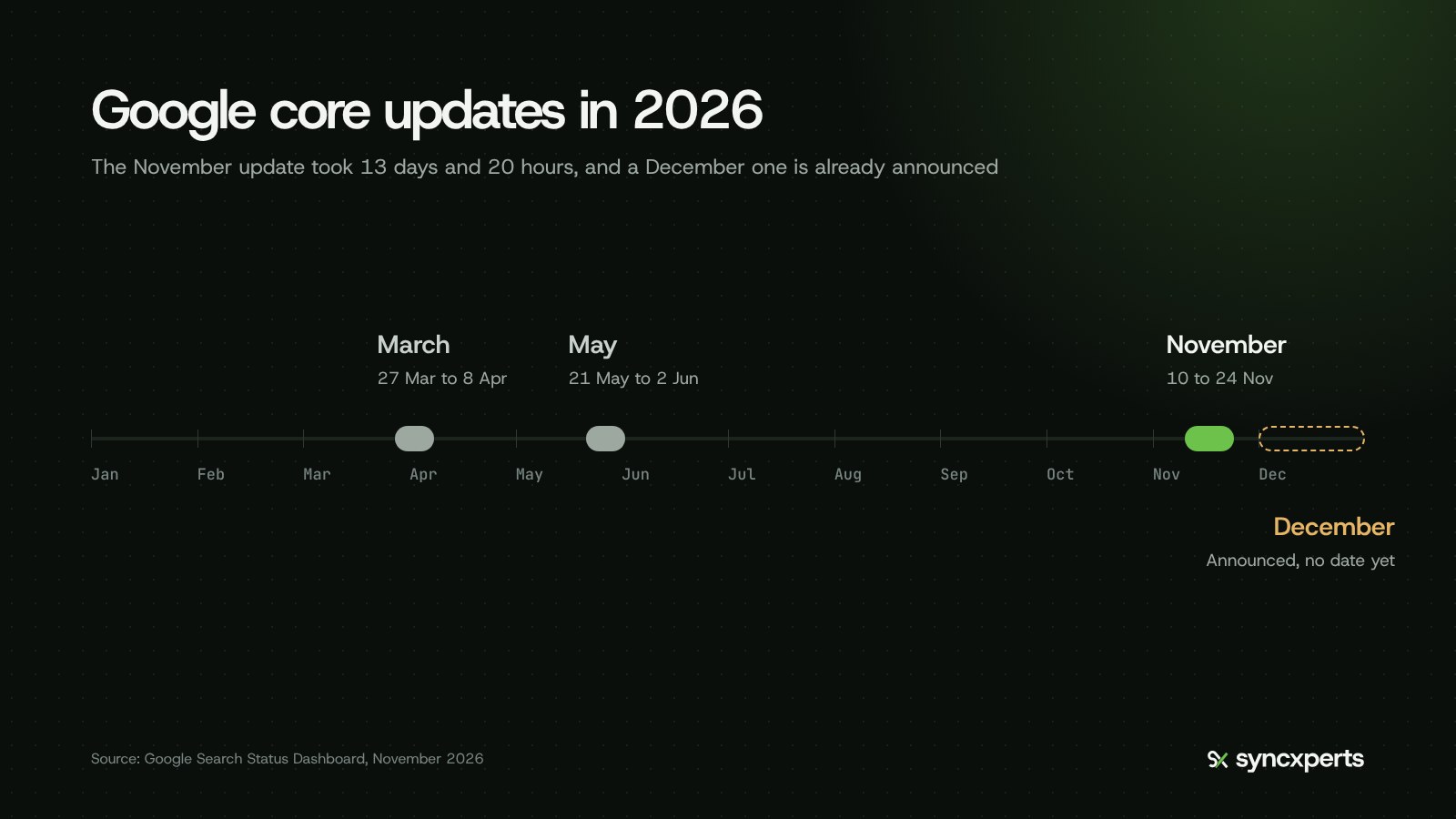
| Update | Started | Finished |
|---|---|---|
| March 2026 core update | 27 March | 8 April |
| May 2026 core update | 21 May | 2 June |
| November 2026 core update | 10 November | 24 November |
| December 2026 core update | Announced 24 November | No date yet |
What Google said
Google said very little. Its Search Central team described it as a regular update to show more relevant, satisfying content from all types of sites, according to Search Engine Roundtable and Search Engine Journal. There was no blog post and no guidance specific to this update. Google pointed site owners to its standing core updates documentation.
That documentation makes one point worth repeating: a drop after a core update does not mean your site broke a rule. Google compares it to a list of the best restaurants. When the list is updated, a restaurant that moves down has not become a bad restaurant. Others may now be judged more useful for that search.
What the trackers saw
These are observations from SEO tools, not statements from Google.
- The biggest movement came around 13 and 14 November. Search Engine Roundtable reported that volatility peaked on 14 November and was milder than a typical core update.
- No single sector stood out in the UK. SISTRIX found no clear winning or losing industry. Several large retailers lost visibility, including zooplus (down about 31%), Habitat (down about 24%) and ASOS (down about 14%), while eBay UK gained about 5%. Reddit lost about 4.5%.
- Tracker data is less reliable than it used to be. Rank tracking companies report that Google has served misleading results to automated rank checkers since September. Your own Search Console data is a better guide than any third party chart.
Reports about AI written content, ecommerce category pages and forums are mixed and mostly anecdotal, so we would not build a plan on them.
How to check your own traffic
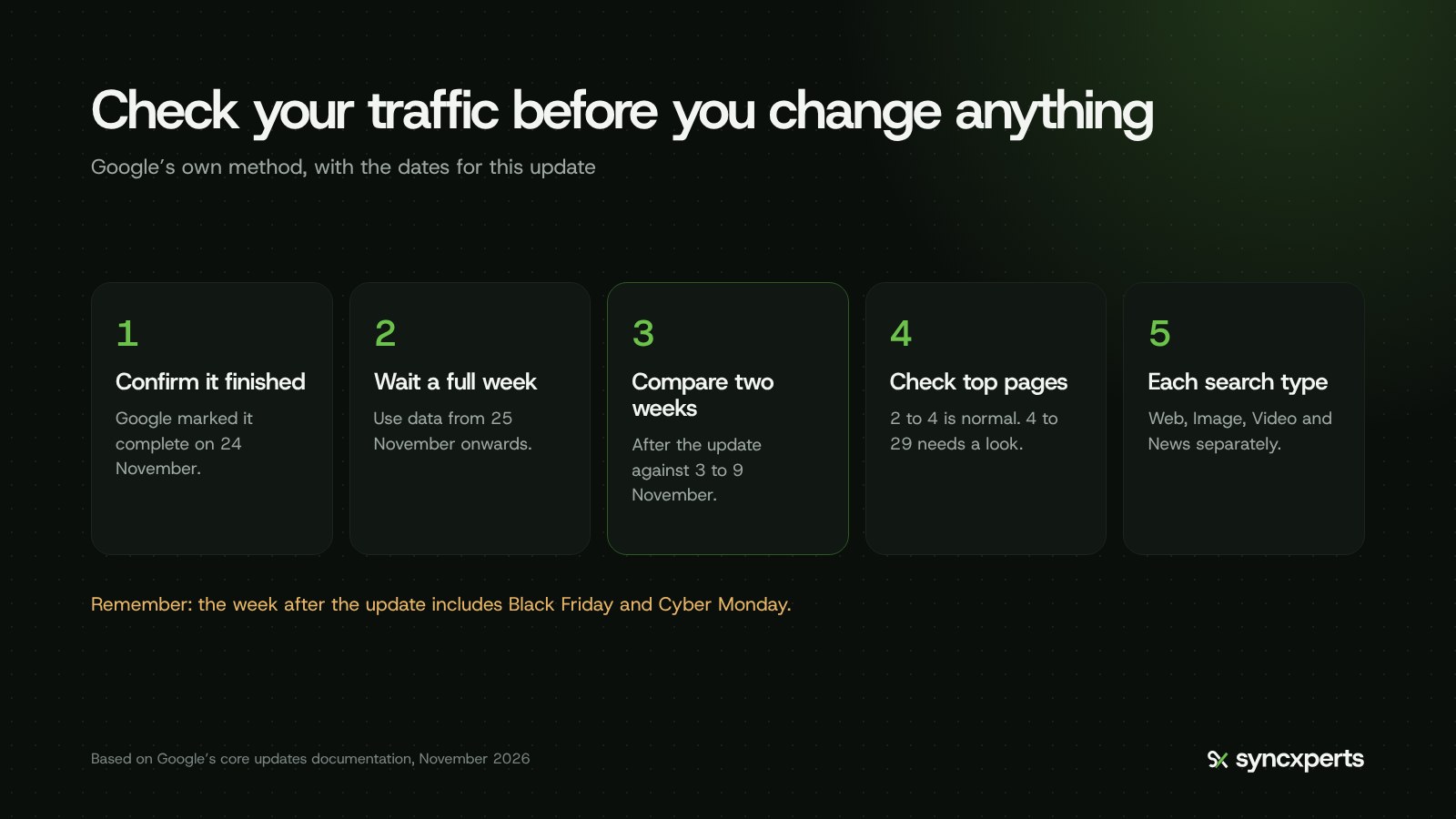
Google's core updates documentation gives a clear method. Here it is with this update's dates.
- Confirm the update is finished. It is: Google marked it complete on 24 November.
- Wait a full week. Judge only data from 25 November onwards, after at least seven days.
- Compare two weeks in Search Console. Open the Performance report and compare the week after the update with a week before 10 November, for example 3 to 9 November.
- Look at your top pages and queries. Google's own example: falling from position 2 to 4 needs no big changes. Falling from 4 to 29 needs a closer look.
- Check each search type separately. Web, Image, Video and News can move differently.
Two things can mislead you this time:
- Black Friday and Cyber Monday. The first full week after the update includes both. Shopping traffic always changes in that week, so compare with the same week last year as well, or wait one more week.
- A Search Console reporting bug. Google says the Generative AI performance report undercounted impressions from 9 to 11 November. It affected the data only, not rankings, but those days sit inside the week you will compare against.
If you did lose rankings
If the drop is large and lasts, Google suggests an honest review of the whole site, ideally by someone not involved in the business. Compare your pages with the ones that now rank above you, and go through Google's own questions on helpful content. In short:
- Does the page give original information, or only repeat what other sites say?
- Is it written or checked by someone who knows the subject?
- Is it clear who wrote it, and is there real experience behind it?
- Would a customer bookmark it or share it with a friend?
- Was it made mainly to help people, or mainly to attract search visits?
Google updated its guidance in October 2026. It now says AI generated content should be fact checked and reviewed, and it calls invented author profiles, such as AI headshots and fake credentials, deceptive. If your blog uses made up authors, fix that first.
For a store, the same thinking applies to product and category pages. Real product photos, clear prices, delivery and return details and honest descriptions help customers, and they are the kind of content Google says it wants to show.
What not to do
- Do not delete pages in bulk. Google calls deletion a last resort.
- Do not chase quick fixes, such as removing page sections or rewriting every title in one go.
- Do not change pages that still perform well.
- Do not change dates to make old posts look fresh. Google lists this as a warning sign.
- Do not expect overnight recovery. Google says it can take months, and sometimes only shows after the next core update. Recovery is not guaranteed.
A December update is already announced
On 24 November, the same day this update finished, Google announced a December 2026 core update. Google says it will improve results for longer and more complex questions, and personalised results for people who have personalisation turned on. A Google spokesperson told Search Engine Roundtable that no date is set yet and it is not coming right away.
Google does not normally announce core updates in advance, so this is unusual. It is a good reason to make careful improvements now and then give them time, rather than reacting twice in one month.
Where we stand
We build and maintain websites and online stores, so we watch updates like this closely for our clients. Most of the time, the right response to a core update is patience and steady work: clear pages written by real people, accurate product information and a fast, simple site.
If your traffic has dropped and you want a second opinion, book a 30 minute call and we will go through your Search Console data with you.
Sources
- November 2026 core update, Google Search Status Dashboard
- December 2026 core update announcement, Google Search Status Dashboard
- Google Search's core updates, Google Search Central
- Creating helpful, reliable, people-first content, Google Search Central
- Stay informed about ranking changes, Google Search Central
- Google's November 2026 core update starts rolling out, Search Engine Journal, 10 November 2026
- Google confirms November 2026 core update is complete, Search Engine Journal, 24 November 2026
- November 2026 core update ranking volatility, Search Engine Roundtable, 16 November 2026
- Google December 2026 core update, Search Engine Roundtable, 24 November 2026
- Generative AI performance report data bug, Search Engine Roundtable, 12 November 2026
- November 2026 core update visibility analysis, SISTRIX
- SEO news roundup, DesignRush, 16 November 2026
Questions owners are asking
It started on 10 November 2026 and finished on 24 November 2026, according to Google's Search Status Dashboard. The rollout took about 13 days and 20 hours.
Google did not give details. It described it as a regular update meant to show relevant, satisfying content from all types of sites. It applies in every country and every language, and Google published no guidance specific to this update.
Wait until at least one full week after 24 November, then compare that week in Search Console with a week before 10 November. Look at your top pages and queries, and keep Black Friday and Cyber Monday in mind, because they change shopping traffic every year.
Not in a hurry. Google advises against quick fixes and says deleting content should be a last resort. Small drops, such as position 2 to 4, need no big changes. Large and lasting drops call for an honest review of the whole site.
Google says some changes show within days, but recovery can take several months, and sometimes only shows with the next core update. Google also says recovery is not guaranteed.
Yes. On 24 November 2026 Google announced a December 2026 core update. It aims to improve results for longer, more complex questions and for personalised results. Google has not given a date.

Founder and CEO of Syncxperts. Builds AI agents, automation, websites and custom software for growing businesses.