
Claude Duet, Meta Muse and Grok Bot: what personal AI agents mean for your business
Meta Muse, Claude Duet, Grok Bot and Google now act for people, and some phone businesses. What this means for your calls and bookings, and what to do this month.

Since 9 September, an AI voice called Hailey or Brett has been phoning businesses for people who use Meta's new Muse app. Pindrop, a company that checks calls for banks, hospitals and shops, says Muse's weekly call volume grew eight times in its first four weeks.
Muse is not alone. In the last seven weeks, xAI launched Grok Bot, Meta opened Muse to small businesses, and on 21 October Anthropic opened a preview of Claude Duet. Google has been calling local businesses for its users for a while now.
This post explains what these personal AI agents are, what changes when one of them contacts your business, and the few things worth doing this month.
The short answer
Personal AI agents now book, buy and ask questions for people. Some of them do it by phone. For a small business this means two things. Some of your customers will reach you through an agent, and you can use an agent yourself for admin work.
To get ready, keep your prices, hours and services clear on your website and Google Business Profile, offer an online booking link, keep your phone menu short, and agree with your team on what you will and won't do for an AI caller.
What personal AI agents are
A chatbot answers questions. A personal agent does tasks for you: it books, fills in forms, sends emails and, in some cases, makes phone calls. These are the ones people are talking about right now.
| Agent | From | What it does |
|---|---|---|
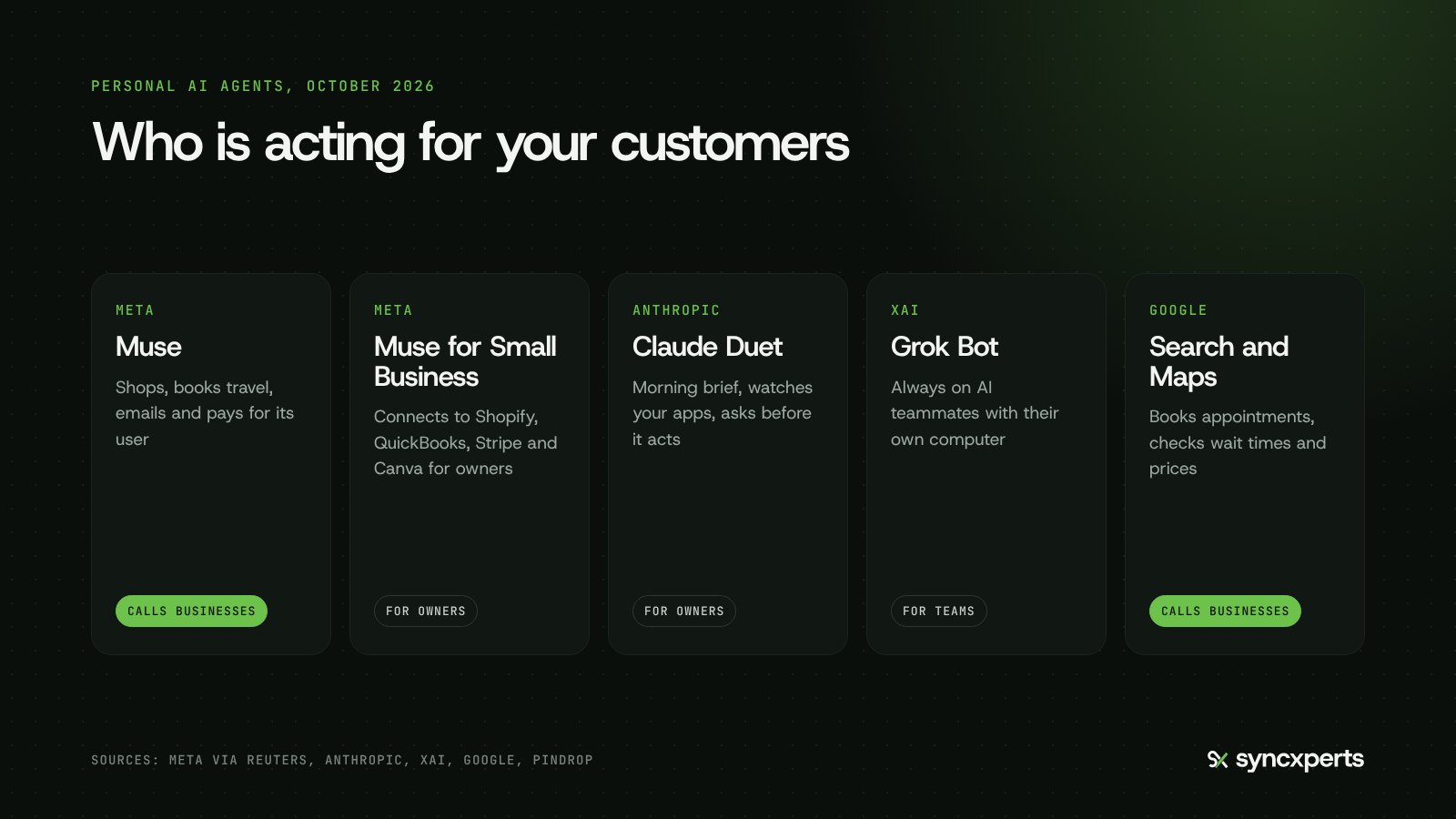
| Meta Muse | Meta | A personal agent for shopping, travel booking, email and payments. It can call businesses for its user. |
| Muse for Small Business | Meta | Connects to Shopify, QuickBooks, Stripe, Canva, Facebook Pages, Instagram and more to help owners run the business. |
| Claude Duet | Anthropic | A proactive assistant that sends a morning brief, watches your apps, takes on tasks and checks with you before acting. |
| Grok Bot | xAI | Always on "AI teammates" that have their own computer and work across apps. |
| Google calling | Calls local businesses for users to book appointments, check wait times and confirm prices. |
Meta's Muse launched in September, and Sensor Tower estimated about 2.8 million downloads in its first two weeks, according to Reuters.
What changes when the caller is an AI
Pindrop's data on Muse calls gives the clearest picture so far.
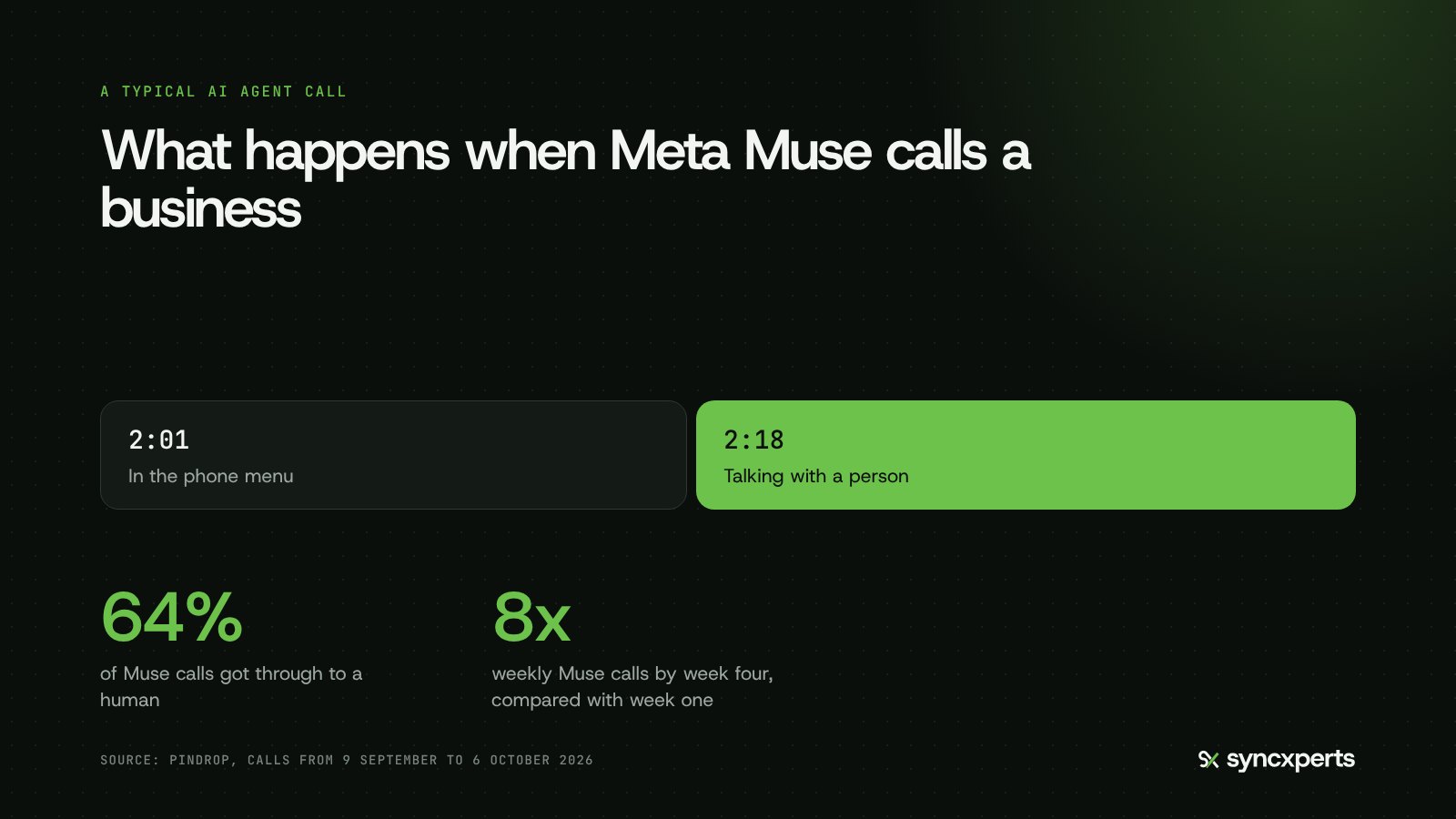
- They reach people. 64% of Muse calls got through to a human.
- They wait like people do. A typical call spent about 2 minutes in the phone menu, then about 2 minutes 18 seconds with a person.
- They call the places people call. Pindrop saw Muse calling banks, healthcare providers and shops, where people usually ring to reschedule an appointment or check on an order.
The hard part is trust. The agent is speaking for someone, and a normal sounding voice tells you nothing about who that person is or what they allowed the agent to do. Pindrop puts it simply: recognising an AI voice does not prove who the customer behind it is.
For most small businesses the practical line is this:
- Fine for an agent: hours, prices, availability, booking or moving an appointment, general questions.
- Needs the real customer: payments, refunds, changing account details, anything private like health or financial records.
What to do this month
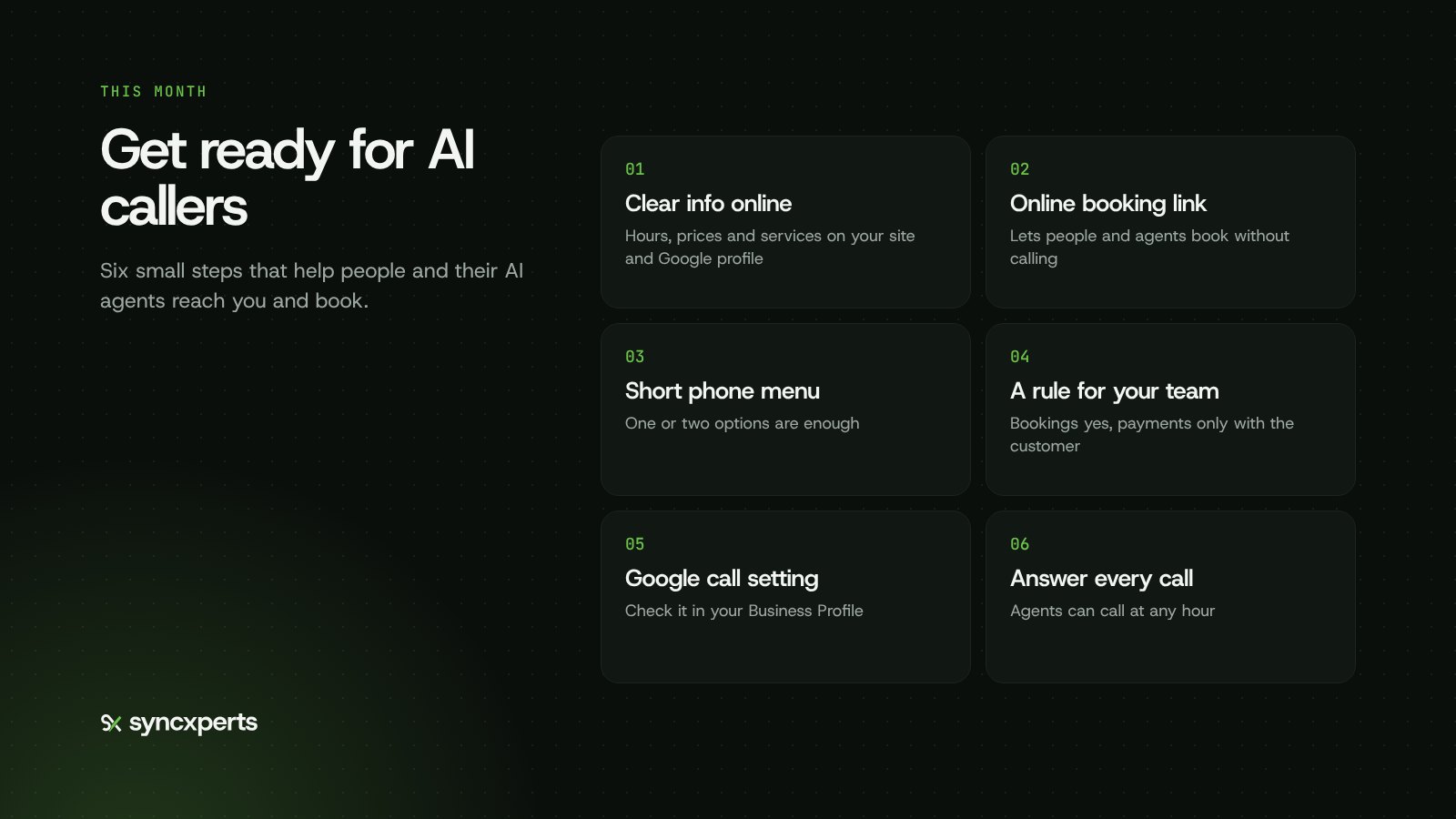
- Put the answers where agents look. Sierra, which is building a standard for these agents with Meta, says most agents today use websites the way people do, loading pages and filling in forms. Make sure your website and Google Business Profile show current hours, prices, services and your address.
- Offer booking without a phone call. An online booking link is the fastest path for a person and for an agent. Google says that if you work with an online booking provider, it may book through that partner instead of calling you.
- Shorten your phone menu. In Pindrop's data, agents sat through about two minutes of phone menu. A shorter menu gets people and agents to an answer faster, and one or two options are enough for most small businesses.
- Write a one line rule for your team. For example: "We help AI callers with bookings and questions. For payments or account changes, we ask to speak with the customer." Put it next to the phone.
- Check your Google setting. In Google Business Profile, under advanced settings, you can opt out of Google's automated calls. If you take bookings by phone, we suggest leaving them on, because those calls bring you customers.
- Answer when they call. Agents can call at any hour. If calls go to voicemail after 6 pm, those bookings go to whoever picks up. This is where an AI receptionist on your own side helps.
Should you use one yourself?
It can help with admin work. Both Meta and Anthropic built in a pause before anything important happens. Meta says Muse won't publish content, send messages or make purchases without the user's approval. Anthropic says Claude Duet checks with you before it acts for you.
Anthropic's launch post has a few early users. A real estate broker had Claude Duet flag a showing that was on her calendar for the wrong day. The owner of a restaurant group with about 110 employees used it for accounting, customer support and marketing, and to go through invoices store by store.
If you try one:
- Start with one boring task, like your inbox or scheduling.
- Connect only the apps that task needs.
- Keep the setting that asks before it sends, posts or pays.
Claude Duet is a research preview, by waitlist, starting with US Pro and Max subscribers. Meta says Muse for Small Business is free for most uses, with paid plans for extra features.
What comes next
On 6 October, Meta and Sierra announced the Personal Agent Protocol, an open standard for how personal agents deal with businesses, with partners including Shopify, Stripe and Walmart. The idea is a direct, secure connection, so an agent can finish a task in seconds instead of clicking through your site or sitting on hold. You don't need to build anything for it yet.
We build AI agents that answer calls and chats for businesses, so we watch this from the other side of the phone. Soon some of the calls your business gets will come from an agent that is working for one of your customers, and you can make that call easy or hard to complete.
If you want your phone and website ready for that, book a 30 minute call.
Sources
- Introducing Claude Duet, Anthropic, 21 October 2026
- Meta expands Muse AI agent for small businesses, Reuters, 29 September 2026
- Inside the detection of Meta Muse, Pindrop
- Introducing Personal Agent Protocol, Sierra, 6 October 2026
- Grok Bot, xAI
- About automated calls and texts from Google to your business, Google Business Profile Help
Questions owners are asking
Often you can't tell from the voice alone, because the new voices sound natural. Ask the caller directly whether they are an AI assistant and who they are calling for. Then decide what you can help with, using the simple rule in this post.
For Google's own automated calls, yes: you can opt out in your Business Profile's advanced settings, or tell Google over the phone. For other agents there is no general off switch yet. If you take bookings by phone, opting out may also mean losing bookings that a customer asked an agent to make.
No. It is a draft standard announced on 6 October 2026, and the first version of the spec was due later that month. Large platforms like Shopify and Stripe are part of it, so if you use them, support will most likely arrive through them. For now, a clear website and an online booking link do more.
It can help with admin like email, scheduling and invoices. Start with one task, keep the setting that asks you before it sends or buys anything, and connect only the apps it needs. Claude Duet is in a waitlist preview, and Meta says Muse for Small Business is free for most uses.

Founder and CEO of Syncxperts. Builds AI agents, automation, websites and custom software for growing businesses.