
Automation as a Service: what it costs, what you own and when it pays off
SaaS sold you seats. Automation as a Service sells finished work. What AaaS means, how it is priced in 2026, the costs in the fine print and what to ask before you sign.

Software used to be sold by the seat. You paid per user per month and did the work yourself. In 2026 a different deal is spreading. Intercom charges from $0.99 each time its AI agent Fin handles a support conversation. Zendesk charges $1.50 to $2.00 per automated resolution. Salesforce sells its agents for $2 a conversation.
You pay for work done, not for a login. That is the idea behind Automation as a Service, often shortened to AaaS. This post explains what it means, how it is priced, where the extra costs sit and how to buy it without getting locked in.
All prices below come from vendor pages checked on 24 October 2026. They change often, so check them again before you buy.
The short answer
Automation as a Service means a provider builds, runs and maintains automations or AI agents for your business, and you pay for the work: per task, per run, per result or a monthly fee to look after it. Tools like Zapier, Make and n8n are still software. They become a service when someone else builds them, watches them and fixes them.
It can save a small team real hours every week. Before you sign, get three things in writing: what exactly you are billed for, which tool costs come on top, and whose name the accounts are in.
AaaS vs SaaS in plain words
In March 2026 the venture firm Sequoia described the split like this. A "copilot" sells a tool to a person who stays responsible for the work. An "autopilot" sells the work itself. Its example: a company might pay about $10,000 a year for QuickBooks and $120,000 for the accountant who closes the books. The second number is the money Automation as a Service goes after.
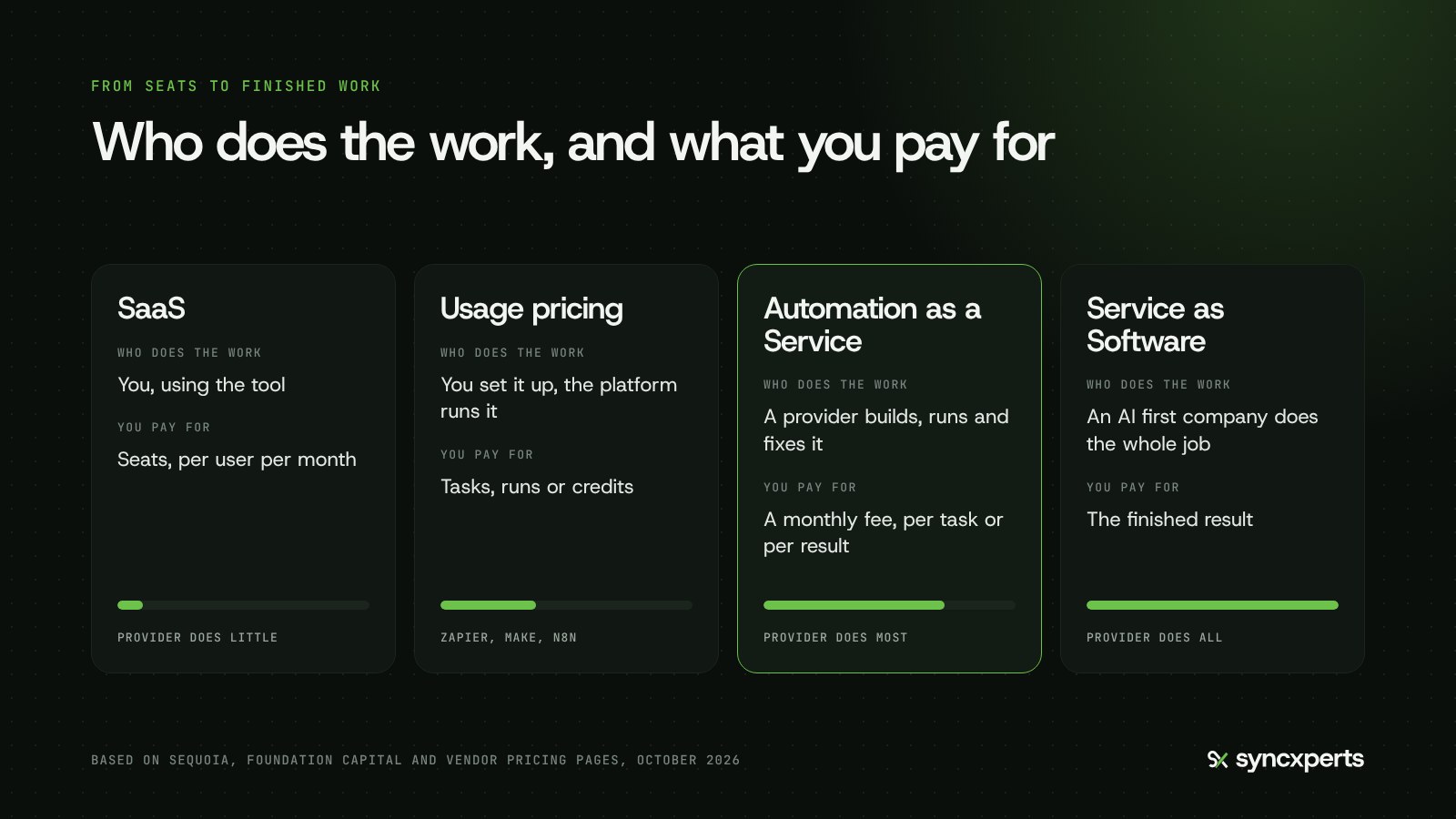
| Model | Who does the work | What you pay for |
|---|---|---|
| SaaS | You, using the tool | Seats, per user per month |
| Usage priced platforms like Zapier, Make and n8n | You set it up, the platform runs it | Tasks, runs or credits |
| Automation as a Service | A provider builds, runs and fixes it | A monthly fee, per automation, per task or per result |
| Service as Software | An AI first company delivers the finished job | The result |
A note on the name. "AaaS" is also used for Agents as a Service, Analytics as a Service and Authentication as a Service. When a provider uses the term, ask which one they mean.
Why everyone is talking about it in 2026
Big vendors stopped selling only seats. Salesforce now prices its Agentforce agents three ways at once: per conversation, per action and per user. Intercom and Zendesk charge per resolved conversation. Gartner called Salesforce's first outcome based AI agent "a sea change" for buyers.
Investors priced it in. In February 2026, after Anthropic released plugins for its Claude Cowork agent, software stocks fell hard. Forrester puts the loss at over $1 trillion of market value in one week. By the end of June, Thoma Bravo's Orlando Bravo said the selloff was over and software stocks had recovered about 13%.
Analysts put a number on it. Gartner says up to $234 billion of business software spending is exposed to AI agents by 2030, and calls the change "less an apocalypse and more of a metamorphosis." Software is not going away, but the way you pay for it is changing.
The tools grew up. n8n, the open source workflow tool many agencies build on, raised $180 million at a $2.5 billion valuation in October 2025.
How Automation as a Service is priced
Four models now sit side by side. Platforms bill per task or per run. AI support agents bill per outcome. Large suites sell credits. Agencies charge a setup fee and then a monthly fee.
| Vendor | You pay per | Published price |
|---|---|---|
| Zapier | Task | Free for 100 tasks a month. Professional from $19.99 a month |
| n8n Cloud | Workflow run, however many steps it has | €20 a month for 2,500 runs, €50 for 10,000. The Community edition is free to host yourself |
| Make | Credit | Free for 1,000 credits a month |
| Intercom Fin | Outcome | From $0.99 per outcome |
| Zendesk AI agents | Automated resolution | $1.50 on a commitment, $2.00 pay as you go, plus agent seats |
| Salesforce Agentforce | Conversation or credit | $2 per conversation, or about $0.10 per action on credits |
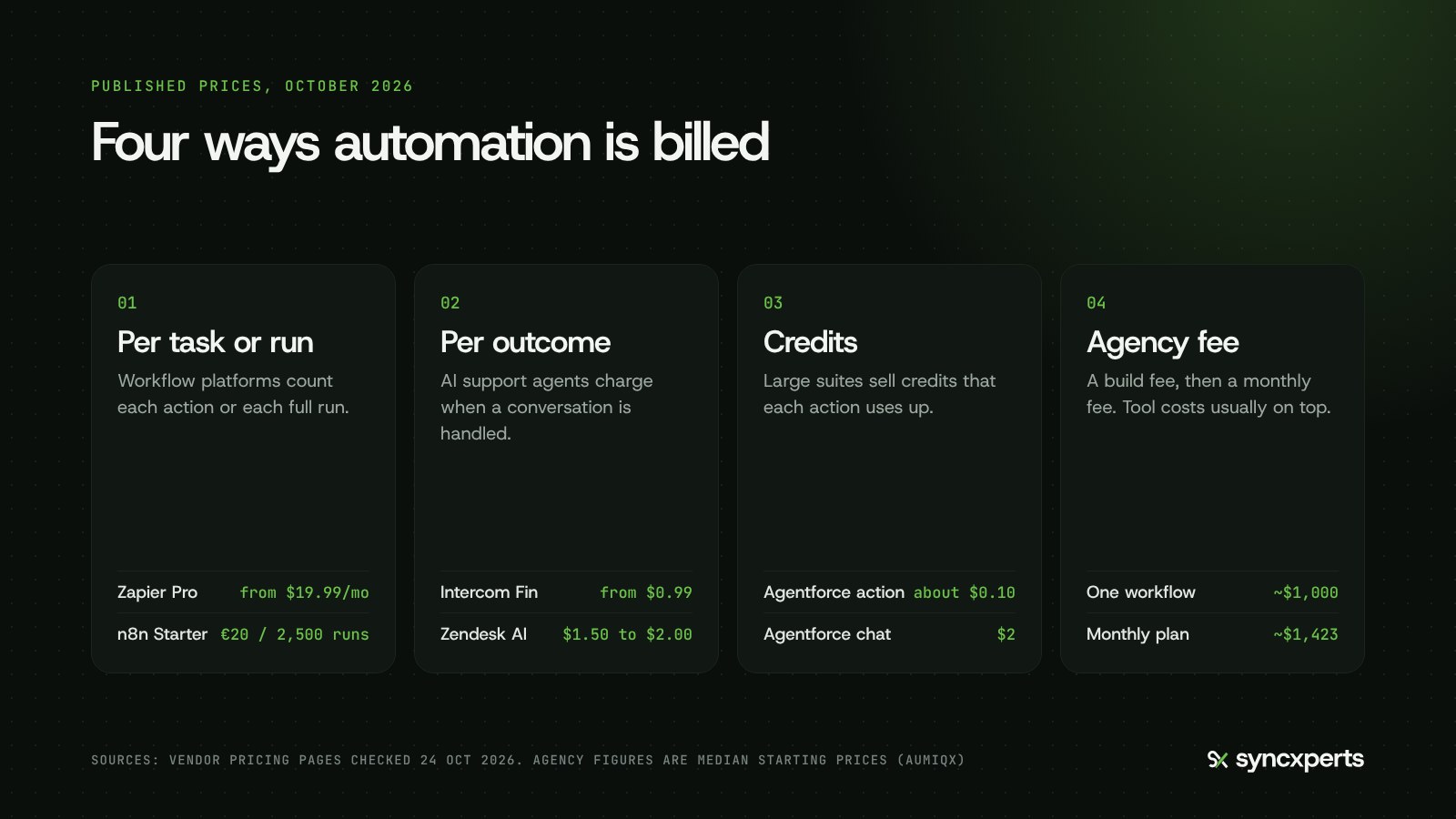
Agency prices are harder to pin down, because agencies publish them themselves. Aumiqx collected the published starting prices of 48 agencies in September 2026. The medians were:
- $1,000 to build one workflow
- $3,558 to build an AI agent or chatbot
- $1,423 a month for a monthly plan that includes new builds
- $286 a month for maintenance and hosting
Those are entry prices. Quotes after scoping, as reported by other agencies, run five to ten times higher, and platform and AI usage is usually billed on top. A fair quote shows the build, the monthly fee and the tool costs as separate lines.
The costs that are not in the quote
Defaults that cost more. Since 15 June 2026, Zapier's AI steps use a multiplier based on the AI model: Standard counts 1x tasks, Advanced 3x and Premium 5x. New AI steps start on Advanced. Pay per task overage is also switched on by default, at a higher rate per task.
Success shows up on the bill. With per outcome pricing, a better agent resolves more conversations and costs more. 1,000 resolutions a month at $0.99 to $2.00 each comes to about $990 to $2,000, before seats.
The vendor decides what counts as done. Intercom counts an "assumed" resolution, where the customer leaves without asking for more help, as an outcome. A handoff to a person counts as an outcome too. Intercom does let you set usage alerts and hard limits, so switch them on.
Credits expire. Salesforce says unused Flex Credits do not roll over. On Make's monthly plans, extra credits you buy expire after a month.
Accounts in someone else's name. With an agency there is a second layer of lock in on top of the platform: their accounts, their API keys and logic only they understand.
You are still liable. In Moffatt v. Air Canada, the airline's chatbot told a customer about a refund policy that did not exist. The tribunal ordered Air Canada to pay $812.02 and rejected the argument that the chatbot was "a separate legal entity." What your AI says, your business said.
Who owns your automations if you leave?
Ask this before the first workflow is built, not on the way out. A good setup looks like this:
- Your accounts. The automation platform, CRM, hosting and API keys are in your business name. The provider is added as a user.
- Your copy. You get an export of every workflow, a simple diagram and a runbook in plain English when it goes live, and again if you part ways.
- A portable stack. Your own Zapier or Make account, or n8n hosted on your server, lowers lock in to the platform as well.
- A clear contract. Workflows built for you become yours once paid, and the provider helps with the handover if you leave.
This is general guidance, not legal advice. Have someone qualified read the contract terms.
When it is worth paying for, and when to do it yourself
Paying a provider makes sense when:
- The task repeats every day or week and follows clear steps.
- You can measure when it is done: a ticket answered, a lead in the CRM, an invoice sent.
- It touches several systems, like your inbox, CRM, accounting and WhatsApp.
- A failure costs you money and nobody on the team has time to watch it.
Doing it yourself is enough when:
- It is one or two simple connections between two apps.
- The volume fits a free plan or one around $20 a month.
- Someone on your team likes building and fixing them.
One study points toward outside help for the harder jobs. In MIT's 2025 research on company AI projects, tools bought from specialist vendors or built with partners succeeded about 67% of the time, and internal builds about a third as often. The study looked at larger companies, so take it as a direction, not a promise.
Questions to ask before you sign
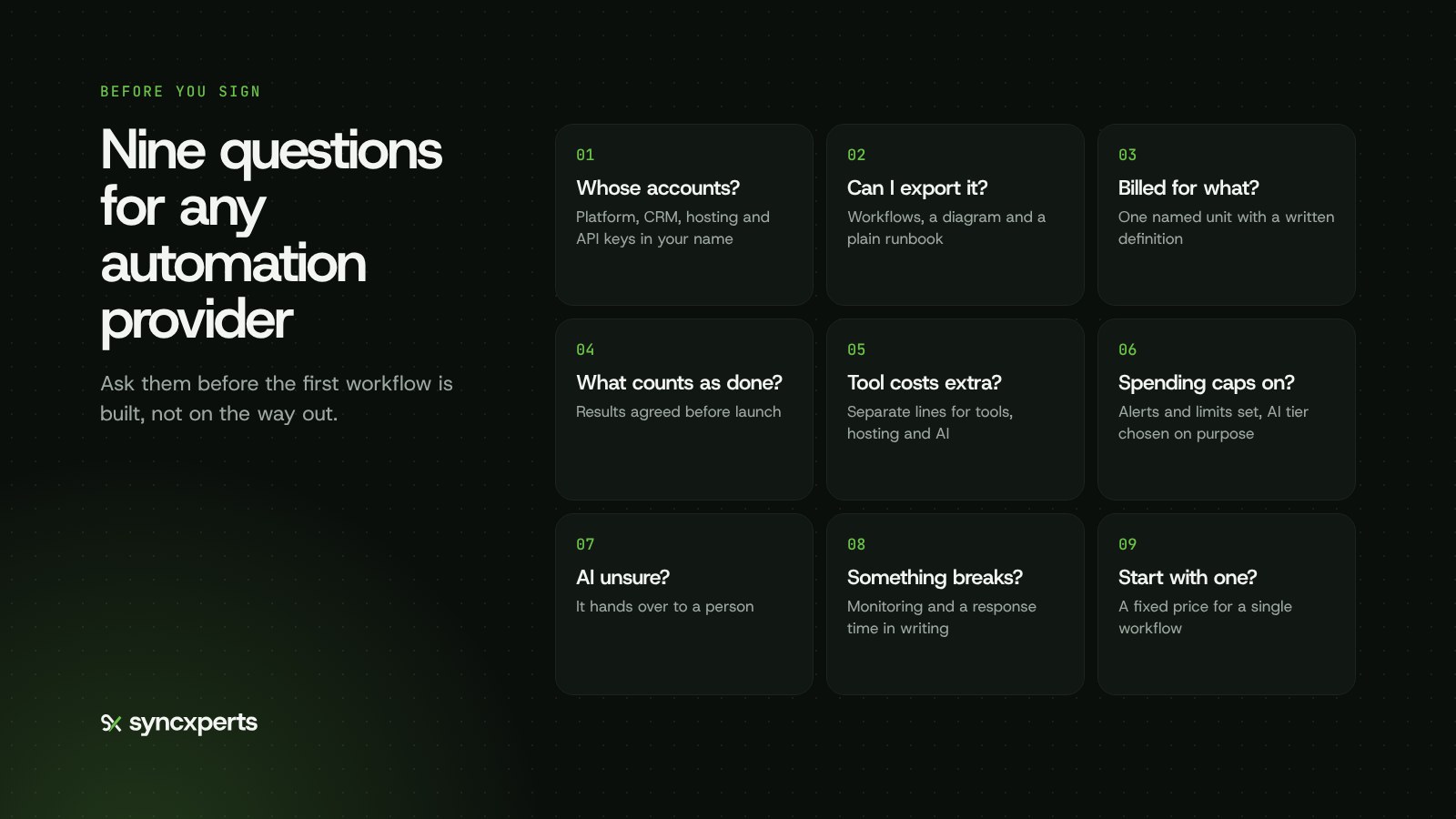
| Ask | A good answer |
|---|---|
| Whose accounts hold the platform, CRM, hosting and API keys? | Yours, with the provider added as a user |
| Can I export the workflows with a diagram and a runbook? | Yes, at launch and again at the end |
| What exactly am I billed for? | One named unit with a written definition |
| What counts as a resolved or qualified result? | Criteria agreed before launch |
| Are tool, hosting and AI model costs included? | Listed as separate lines in the quote |
| Are spending caps and alerts switched on? | Yes, and the AI tier was chosen on purpose |
| What happens when the AI is unsure? | It hands over to a person |
| What happens when an app changes and a workflow breaks? | Monitoring, alerts and a response time in writing |
| Will you price one workflow as a pilot? | Yes, a fixed price |
What the skeptics get right
Gartner expects over 40% of agentic AI projects to be cancelled by the end of 2027 because of rising costs, unclear value or weak risk controls. It also warns about "agent washing", where old chatbots and RPA get a new label, and estimates only about 130 of the thousands of vendors selling AI agents are the real thing.
In a Carnegie Mellon test from mid 2025, the best AI agent fully finished 30.3% of simulated office tasks. Those models have since been replaced by better ones, but the lesson still holds. Start with one workflow, measure it, and keep a person in charge wherever money or private data is involved.
Where we stand
We build automations and AI agents for businesses on n8n, Make, Zapier and custom code, so we are on the selling side of this. Every workflow we build is monitored and documented, and your team gets a walkthrough at handover.
Our advice is the same either way. Start with one workflow, ask the questions above, and ask them to us too. If you have a task in mind, book a 30 minute call.
Sources
- Fin pricing, Intercom Help, 23 September 2026
- Zendesk pricing
- Agentforce pricing, Salesforce
- AI by Zapier model based pricing from 15 June 2026, Zapier Help
- Zapier pricing
- n8n pricing
- Make pricing
- Services: The New Software, Sequoia, 5 March 2026
- Gartner on $234 billion of software spend at risk from agentic AI, 1 July 2026
- Gartner predicts over 40% of agentic AI projects will be canceled by end of 2027, 25 June 2025
- SaaS as we know it is dead, Forrester
- Software stocks hit by AI disruption fears, Reuters via BNN Bloomberg, 4 February 2026
- The SaaSpocalypse may be ending, Forbes, 30 June 2026
- Salesforce now has 3 pricing models for Agentforce, SaaStr, 17 February 2026
- n8n reaches $2.5 billion valuation, Bloomberg, 9 October 2025
- AI automation agency pricing data, Aumiqx, 23 September 2026
- MIT report on generative AI pilots, Fortune, 18 August 2025
- AI agents fail a lot, The Register, 29 June 2025
- Air Canada ordered to pay over chatbot's advice, CX Today, 19 February 2024
Questions owners are asking
There is no standard price. Published agency starting prices collected in September 2026 had medians of about $1,000 for one workflow and $1,423 a month for a retainer, and quotes after scoping often land several times higher. Tool fees for Zapier, Make, n8n, AI models and hosting usually come on top, so ask for them as separate lines.
No. With SaaS you pay for access and do the work yourself. With Automation as a Service a provider builds, runs and fixes the automations, and you pay for the work or for looking after it. The tools underneath are often the same.
Not quite. RPA bots repeat fixed clicks on screens. Most automation today connects apps through their APIs and adds AI steps for work like reading an email or answering a question. Some vendors relabel old RPA as agentic AI, so ask what the system actually does.
Yes, and it is the safest way to start. Ask for a fixed price for one workflow, a written definition of done and a handover document. Decide on a monthly plan after you have seen it run.
Your business. In Moffatt v. Air Canada (2024) a tribunal made the airline pay after its chatbot gave a customer a refund policy that did not exist. Keep a person in the loop for payments, refunds and private data.
It depends on whose accounts they live in. If the automation platform, API keys and hosting are in your name and you have an export and a written runbook, another team can take over. If they are in the provider's name, you may have to rebuild.

Founder and CEO of Syncxperts. Builds AI agents, automation, websites and custom software for growing businesses.